
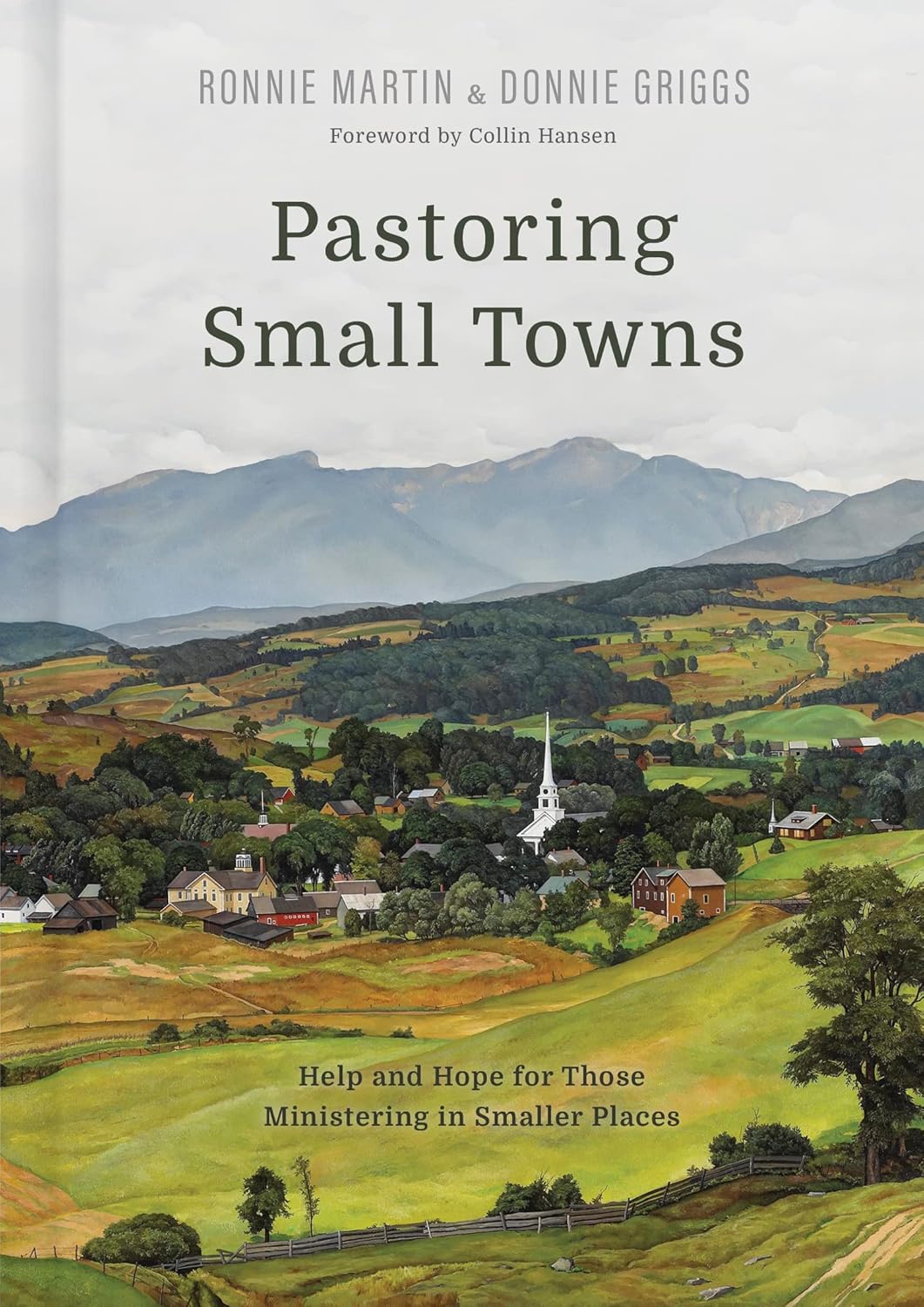
Authors: Ronnie Martin and Donnie Griggs (Foreword by Collin Hansen)
Publisher: B&H Publishing Group
Published: 2023
Pages: 187
Format consumed: Physical copy (hardcover)
Most books on pastoral ministry are written for pastors in big cities with big budgets and big congregations. The assumption is that if you are not leading hundreds, you are not leading well. If your church does not have a website, a podcast, and a communications team, you are behind. And if you are pastoring in a place most people have never heard of, well — maybe you should aim higher.
Pastoring Small Towns pushes back on all of that. And it does so with the quiet conviction of two pastors who chose to stay.
I first came across the title through an Instagram post that recommended it. So when I spotted it at a BookSale store in SM — marked down to just 65 pesos, barely over a dollar, from a retail price of around 770 pesos or 13 USD on Amazon — I grabbed it immediately. As a church planter, I am always on the lookout for books about pastoring in smaller settings. And at that price, I did not think twice.
I started reading in early February 2026 and finished it in March. It is a quick read — just ten chapters, 187 pages. It took me about a month only because of family commitments, a speaking engagement, and the fact that I was simultaneously listening to another book on pastoral ministry, Letters to a Young Pastor by Eric and Eugene Peterson (see my review here). Left uninterrupted, you could finish this in a few sittings.
Each chapter focuses on a single character trait that pastors need to develop: love, compassion, patience, courage, wisdom, humility, faithfulness, multiplying, and endurance (the last two chapters both deal with endurance). The chapter titles are one word, followed by a subtitle that explains what the trait looks like in practice. Simple. Direct. No fluff.
The book is co-authored by Ronnie Martin, lead pastor of Substance Church in Ashland, Ohio, and Donnie Griggs, who planted One Harbor Church in Morehead City, North Carolina. They alternate chapters throughout the book. And both of them write not from the ivory tower of theory, but from the trenches of actual small-town ministry. This is not theory. This is testimony.
One Book, One Message
If I could summarize this entire book in one word, it would be sheep.
Everything in this book orbits around that image. From the very first chapter on love to the final chapter on endurance, Martin and Griggs keep circling back to one question — the question that every pastor, whether in a small town or a big city, needs to sit with honestly:
Am I doing this for the flock? Or for myself?
Chapter 1, written by Donnie Griggs, sets the tone immediately. He draws on the imagery of the Good Shepherd in John 10 — the shepherd who guards the sheep versus the hireling who flees when danger comes. One does it out of love. The other does it for the paycheck. And in pastoral ministry, the difference between the two will eventually show.
Griggs is honest about the challenges. Small-town ministry means less anonymity. You will run into your members at the grocery store, at the gas station, even on your date night. He tells a story of going out to dinner with his wife — candles on the table, clearly a date — and a church member walked up and said, “Looks like you guys are on a date,” then proceeded to ask for advice right there and then.
Have you been there? That moment when you are not on duty but the ministry does not care?
He also talks about the limited restaurant choices, the lack of privacy, the feeling of being watched all the time. These are real frustrations. And if you are not genuinely in love with the people and with God, these frustrations will wear you down until you start looking for the exit.
But here is where Griggs turns it around. He says all these difficulties are a gift. They are a gift because they expose our motives. If you are in ministry for the spotlight, small-town life will expose that fast. And the remedy? Love Jesus more. Spend time with Him. And then let that love overflow to others. He writes on page 21 that the best way to get more love for the sheep is to love Jesus more.
I had to put the book down for a moment after reading that.
Compassion, Patience, and the Slow Work of God
Chapter 2, written by Ronnie Martin, takes us to Mark 6. The disciples have just come back from a season of intense ministry — healing, casting out demons, performing miracles. They are spent. And what does Jesus do? He does not give them another assignment. He does not pull up the next quarterly report. He tells them to rest.
Think about that. Jesus saw His inner circle not as employees who need to be managed, but as people who need to be cared for. That is the heart of compassion. And it is a rebuke to every pastor — myself included — who treats rest as weakness.
But the story does not end there. As they tried to get away, the crowd followed them. And instead of turning them away, Jesus began to teach, because they were like sheep without a shepherd. The lesson is painful in its honesty: rest is important, but people are desperate. And sometimes, both truths exist at the same time.
Chapter 3, on patience, hit close to home for me as a church planter. Change is slow in ministry. Painfully slow. And in a culture that measures success by how fast things grow, that can feel like failure. But Martin reminds us that the Bible compares spiritual growth to the growth of trees and plants. Trees do not grow overnight. You plant. You water. You wait. And you trust God for the growth.
He uses the story of Mary and Martha to make the point that even pastors — especially pastors — need to sit at the feet of Jesus and slow down. You cannot pour from an empty cup. And you cannot rush what only God can grow.
Where the Book Stumbles
I want to be honest. Not every chapter landed with the same force. And this is where the book loses me a little.
Chapters 4 and 5 — on courage and wisdom — made valid points, but the execution did not match the weight of the topics. Chapter 4 argues that pastors must be courageous enough to confront difficult issues — addiction, racism, division — even if it means losing members. That is a necessary message. But the writing did not pull me in. It felt flat.
Chapter 5, on wisdom, discusses delegating tasks, building relationships with fellow pastors, and using social media effectively. All good counsel. But the chapter felt scattered. I finished it and found myself asking, What was the central thesis again? If I had to reconstruct it, I would say the point is that pastors should not carry the burden alone — they should work smart, delegate, and lean on their peers. That is important. But it could have been said with more clarity and more force.
This is a pattern I noticed in several chapters throughout the book — not just these two. Some chapters try to cover too many ideas instead of driving one central point home. The result is that you walk away remembering the good chapters vividly and the weaker ones only vaguely. For a book with only ten chapters, that unevenness is felt.
I mention this not to be harsh but to be fair. A good book deserves honest feedback.
The Chapters That Redeemed It
Chapter 6 on humility brought the book roaring back.
Griggs makes an observation that surprised me: small-town ministry creates a unique and often unrecognized temptation — a fast route to celebrity status. In a small community, the pastor becomes known quickly. Respect comes easily. People look to you. They listen to you. And before you know it, you start thinking more highly of yourself than you should.
He uses Peter as the example. Peter was affirmed by Jesus for confessing Him as the Messiah. And then, riding on that affirmation, Peter had the audacity to rebuke Jesus. Affirmation became presumption. Confidence became pride. And ministry — even something as noble as ministry — has a way of doing that to a person.
This hit me. Because humility and love are inseparable. Without love, humility is hard. And without humility, loving others becomes almost impossible.
But the chapters that truly stood out — my favorites in the entire book — were chapters 7 and 8. Both written by Donnie Griggs. And if you read nothing else from this book, read these two chapters.
Chapter 7 is about faithfulness. And it is a must-read for every pastor alive today.
In an age of social media, it is dangerously easy for pastors to focus on audiences outside their immediate congregation. Building an online following, speaking at conferences, getting retweets and likes — none of these are inherently sinful. But they become dangerous when they start replacing the quiet, often mundane, often unseen work of local shepherding. The work that nobody posts about. The work that nobody applauds.
You will not always feel valued. You will not always see change. Your sermons might feel like an old record that keeps on playing. But that is the fight. We are called to be faithful even when it means not being seen by the masses.
We go back to the basic question: Am I doing this for the flock? Or for my self-interest?
Lead even if no one is watching. Focus on the One who is watching.
Chapter 8, on multiplying, is equally powerful. Griggs argues that while it is important for a pastor to be present for his people, it is dangerous to let the entire ministry revolve around one person. It feeds pride. It creates a fragile ministry. And it stunts the growth of everyone else.
He lists the dangers in developing leaders: people who see the ministry as a stepping stone to something bigger, people who share your doctrines but not your philosophy of ministry, people who join only when it is convenient for them. Instead, he urges pastors to invest in people who are reliable, teachable, and who love the ministry for what it is — not for what it can lead to.
As a church planter, I can relate to every single one of those dangers.
But what I appreciated most was the emphasis on discipleship outside of church services. The meals, the walks, the conversations in their homes — that is where trust is built. That is where discipleship actually happens. We do not only proclaim from the pulpit. We disciple in the park, in the living room, in the ordinary rhythm of life.
Finishing the Race
Chapters 9 and 10 both deal with endurance. And they are the perfect way to close this book.
Chapter 9, written by Martin, and Chapter 10, written by Griggs, address the one temptation that every pastor has faced at one point or another: the temptation to quit.
Chapter 10 hit me the hardest. Griggs writes about the pull toward greener pastures. The fantasy that somewhere out there, ministry would be easier. The weariness that builds up over months and years until one day you wake up and you are not sure if you want to keep going.
And he does not dismiss any of it. He does not slap a Bible verse on it and say, “Just pray more.” He acknowledges that the temptation to quit is real. It is not a sign of weakness. It is a sign of being human. And it felt good — genuinely good — to know that someone out there understands. Someone has been there. Someone gets it.
The last chapter encourages one thing above all else: find friends in ministry. Find people you can be honest with, cry with, journey with.
This is easier said than done. We pastors have a tendency to play superman. We feel like we always need to be the one rescuing. And we are afraid — deeply afraid — to admit that we, too, need help. But the book reminds us that we can finish the race, as Paul did. By the grace of God, it is possible. It can be done.
Lessons from the Book
Love must be the foundation of ministry. The best way to grow in love for your congregation is to grow in love for Jesus. Everything flows from that.
Compassion sees people as sheep, not as projects. People are needy, clumsy, and sometimes intrusive. Meet them with the heart of a shepherd, not the impatience of a manager.
Patience is the posture of a farmer. Spiritual growth is slow. Do not rush people. Do not rush yourself. Sit at the feet of Jesus and learn to trust His timing.
Courage means confronting what is wrong, even at a cost. Faithfulness to God must come before popularity with people.
Ministry should not revolve around one person. Delegate. Develop leaders. Invest in people who are reliable, teachable, and who genuinely love the work.
Lead even when no one is watching. Faithfulness in the unseen places is the truest measure of pastoral integrity.
Difficulties expose motives. Every challenge in ministry is an opportunity to examine whether we are doing this for God and for the sheep — or for ourselves.
Find friends in ministry. You cannot finish the race alone. Find people who understand the weight of the calling and walk with them.
Final Thoughts
Pastoring Small Towns is not a long book. It is not a complicated book. But it is an honest one. And in a world full of polished, Instagram-worthy ministry content, honesty counts for something.
That said, the book is uneven. When it is good — chapters 1, 6, 7, 8, and 10 — it is really good. The writing is personal, the insights are sharp, and the pastoral heart behind the words is unmistakable. But when it stumbles, it stumbles noticeably. Some chapters have scattered points instead of one clear, driving idea, and the writing in those sections could have been stronger. For a book with only ten short chapters, that inconsistency weighs on the overall experience.
Although the book is written for pastors in small-town America, the principles are universal. Whether you are pastoring in a rural area in North Carolina or planting a church on a university campus in the Philippines, the core questions remain the same. Am I loving the sheep? Am I doing this for God or for myself? Am I willing to endure?
I bought this book for 65 pesos at a BookSale store. At that price, it was well worth it. At full retail, I would say temper your expectations — the strongest chapters are worth your time, but the book as a whole does not consistently deliver at the same level.
One quote from the book that I keep coming back to: It doesn’t matter if it is easier somewhere else because God hasn’t put you somewhere else. He has you right where He wants you, and, good news, that means He can work with whatever you’ve got (p. 135).
That is the message I needed to hear. And perhaps you do too.