
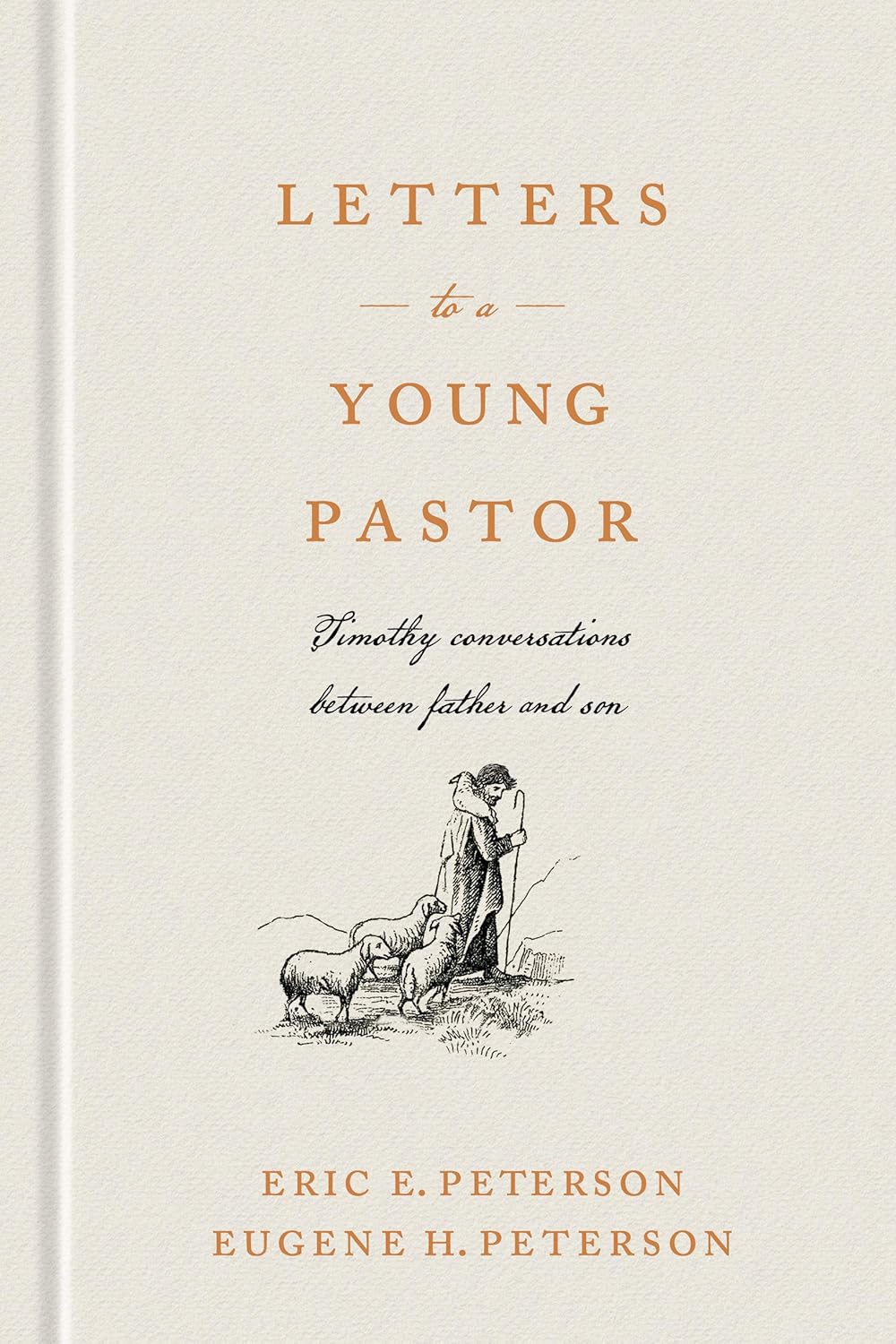
Author: Eric E. Peterson (compiled from the letters of Eugene H. Peterson)
Publisher: NavPress (The Navigators)
Published: 2020
Format consumed: Audible audiobook
There are books that teach you how to be a pastor. And then there are books that remind you why you became one.
Letters to a Young Pastor is the latter.
I listened to this book via Audible, while doing house chores, while just lying on my bed at the end of the day. And I’ll be honest, there were moments where I had to pause the audio, stare at the ceiling, and just sit with what I had just heard. This is not a book you rush through. It asks you to slow down. It asks you to reflect.
Letters to a Young Pastor is a collection of thirty-seven letters written by Eugene H. Peterson, author of The Message, A Long Obedience in the Same Direction, and over thirty other books, to his son, Eric, who had recently planted a new church in Colbert, Washington. The letters span from Christmas Day 1999 to June 2010, over a decade of correspondence between a father and a son, both of whom share the pastoral calling. Eric compiled and published these letters in 2020, two years after Eugene’s passing in 2018.
What makes Letters to a Young Pastor different from most pastoral ministry books is its form. These are not lectures. These are not how-to manuals. They are letters, intimate, unhurried, full of the texture of everyday life. Eugene writes about the weather in Montana. He writes about hiking with Jan, his wife. He talks about the books he is reading, the people he has been visiting, the funerals he has attended, the sermons he has been mulling over. And woven through all of it, like a thread you almost miss if you’re not paying attention, is the deepest kind of pastoral wisdom, the kind that doesn’t announce itself but simply shows up.
The Heart of the Book
If I had to summarize Letters to a Young Pastor in one sentence, it would be this: The pastoral vocation is deeply, irreducibly personal.
Eugene makes this point again and again, in different ways, across different letters. Being a pastor is not about being a manager of a religious organization. It is not about making sure all the technical operations of church and ministry are running smoothly. While those things are important, and they are part of the work, they are not the heart of it. The heart of pastoral ministry is loving people toward a saving relationship with Jesus Christ.
And that convicted me.
Because when I look at my own ministry, I sometimes catch myself measuring success in metrics, in attendance, programs, and outputs, rather than in names and faces.
What struck me most as I listened was how Eugene and Eric talk about people. The letters are filled with names: parishioners they have encountered, friends they have remembered, neighbors they have walked alongside through grief and joy and the ordinary rhythms of life.
Eugene writes about Norval Hegland, a retired Norwegian pastor who loved flying airplanes. He was eighty-six when he passed. In the final weeks of Norval’s life, Eugene visited him several times, sitting with him while his daughters took turns keeping watch. Eugene didn’t talk about what he said during those visits. He talked about how honored he felt just to be there. That’s what stayed with me. He didn’t see it as a pastoral duty. He saw it as a privilege.
Then there’s Betty, a woman in Eric’s congregation. Eugene never met anyone quite like her. She was a praying woman, mature, never self-conscious about her “leadership gifts,” never asserting herself. She was simply there, faithful and quiet, and her presence in the church modeled what it meant to live as the body of Christ, not the head. When she passed, Eugene wrote to Eric that he envied him for having had such a person in the life of his church. He wished he had someone like Betty in his own early years of ministry. He didn’t even know people like that existed.
And then there’s the image of Matt Matthews helping plant white pines around the borders of Christ Our King Church. Eugene kept returning to that memory across the letters as a metaphor for what church building really is: not hammering something together, but placing something in the ground and watching all heaven and earth make it grow. Slowly, slowly, slowly.
These are not illustrations pulled from a sermon book. These are real people, real lives, real relationships that shaped their ministry. And the way Eugene and Eric talk about them, you can tell they genuinely treasured these people.
Eugene reminds us that a pastor is not the hero of other people’s stories. A pastor’s job is to help people meet the Hero of their stories: Jesus.
People-Driven, Not Performance-Based
One of the strongest themes running through Letters to a Young Pastor is Eugene’s pushback against what he calls the “American” model of pastoral success. He resists the reduction of pastoral ministry to performance metrics and KPIs. He is troubled by the culture of celebrity pastors. He is suspicious of the pastor as CEO, the pastor as vision caster, the pastor as brand.
Instead, Eugene insists that pastoral ministry is first and foremost people-driven. It is relational, not transactional. It is about being a companion in pilgrimage, walking alongside people through the mess and wonder of their lives, not about standing on a stage and delivering polished performances.
In one of the later letters, he describes one pastor’s style as “pastor as companion in pilgrimage,” and contrasts it with what he sees too often: pastor as instructor, pastor as cheerleader, pastor as organizer. That distinction is one I have been wrestling with in my own ministry.
He also says something in the later chapters of Letters to a Young Pastor that I found deeply refreshing. He admits that he does not know everything about pastoral ministry. In writing his memoir, he did not want to give the impression that he is the model of an American pastor. He correctly understood that pastoral ministry is profoundly context-based. Every local congregation is different. Every community has its own culture, its own wounds, its own gifts. There is no one-size-fits-all template for being a faithful shepherd.
And he is right. I have felt this as a church planter. The pressure to replicate someone else’s model, someone else’s success story, is constant. But Eugene gives us permission to trust the unique calling that God has placed on each of us, in the specific place where He has planted us.
He is also against giving pastors celebrity status. The moment the pastor becomes the brand, something essential about the vocation is lost. Pastors should never think they are the most important person in the room. Nor should they swing to the opposite extreme and think they are not needed or obsolete. The truth, as Eugene modeled it, lies somewhere in the middle: we are called, we are needed, and we have much still to learn.
The Importance of Rest
Another lesson that stayed with me was the theme of sabbatical rest.
Eugene talks about this with particular care, especially as Eric was navigating the accumulated fatigue of years of church planting. At one point, Eugene reflects on his own midforties, a period where the adrenaline of the early years had worn off and a feeling of vulnerability set in. He knew what it was like to be tired in ministry.
He believed, and I think he was right, that occasional sabbatical rests are good for both pastors and their congregations. For the pastor, it is an opportunity to be renewed in faith and vision. For the congregation, it is an opportunity to realize that the pastor is not indispensable, that the church does not rise or fall on one person. The community learns to rely on God and on one another in the pastor’s absence. And that is healthy.
This is a lesson I need to hear regularly. In a culture that glorifies busyness and equates exhaustion with faithfulness, the reminder that rest is not a sign of weakness but a spiritual discipline is both countercultural and deeply biblical.
Good Pastors Should Be Good Readers
One of the most consistent themes across all thirty-seven letters is Eugene’s love of books.
Nearly every letter mentions something he is reading, something he is writing, or something he wants to recommend to Eric. He reads widely: theology, poetry, novels, biographies, philosophy. He engages with writers like Wendell Berry, Jacques Maritain, Karl Barth, and Gerard Manley Hopkins. He references the Aeneid in one letter and a Philip Larkin poem in another. He mentions working through the thick volumes of N.T. Wright. He is constantly thinking about what he is reading and how it connects to the pastoral life.
This is not intellectual showmanship. For Eugene, reading was a pastoral discipline. It was how he kept his mind sharp and his heart soft. It was how he continued to grow, even in his later years.
The lesson is clear: good pastors should be good readers. We do not know everything. The challenges of ministry are too vast and too varied for any one person to navigate on instinct alone. We need the wisdom of others, the living and the dead, to sharpen our minds and ready our hearts.
This challenged me. In the busyness of ministry and everything else that fills a week, it is easy to let reading slip. But Eugene’s letters are a reminder that books should always be a part of the pastoral life. Not as a luxury. As a necessity.
Lessons from the Book
Pastoral ministry is a vocation, not a career. A vocation is a calling, something you are drawn into by God, not something you build for yourself. Eugene’s letters consistently frame pastoral work as a response to God’s initiative, not a platform for personal ambition.
The pastor is a companion, not a CEO. Eugene pushed back against the model of the pastor as corporate leader. The pastoral task is relational: walking with people, praying with people, being present in people’s joys and sorrows.
Context matters. There is no universal formula for pastoral ministry. What works in one congregation may not work in another. Faithfulness looks different in different places, and that is by design.
Rest is a discipline, not a weakness. Sabbatical rest protects the pastor from burnout and teaches the congregation to depend on God rather than on one person.
Read widely and read often. Eugene modeled this throughout Letters to a Young Pastor. A pastor who stops reading is a pastor who stops growing.
Cherish people over programs. The letters are filled with the names and stories of real people. Ministry is measured not in metrics but in relationships.
Resist the celebrity model. The moment a pastor becomes a brand, something essential about the vocation has been lost.
Embrace the slow work of God. Church planting and spiritual formation are not fast. Eugene compared it to planting trees: slow, patient, trusting that God gives the growth.
Humility is the posture of a lifelong learner. Even at the end of his life, Eugene was still learning, still reading, still asking questions. That is the mark of a faithful shepherd.
Final Thoughts
Letters to a Young Pastor is not a book that will give you a five-step plan for growing your church. It will not teach you how to increase your Sunday attendance or optimize your small group strategy. If that is what you are looking for, this is not your book.
But if you are a pastor — or anyone who cares about what it means to live a faithful life — and you are tired of the noise, tired of the performance metrics, tired of feeling like a glorified manager rather than a shepherd of souls, then Letters to a Young Pastor will feel like a long drink of cold water.
Eugene Peterson wrote these letters to his son. But as I listened, I could not help but feel that he was writing to me too. To every young pastor who has ever felt in over his head. To every minister who has ever wondered if what he is doing matters. To every shepherd who has forgotten that the work is not about him — it is about helping people meet Jesus.
Letters to a Young Pastor is tender. It is honest. It is unhurried. And it is full of the kind of wisdom that only comes from a lifetime of faithful, ordinary, Christ-centered ministry.
Definitely a must-read. I will probably re-listen to this book again this year.
Summary, verdict and frequently asked questions
A reference summary compiled from the review above. It is not part of the original review.
Book Review Summary
Letters to a Young Pastor at a glance


Best for: any young pastor, church planter, or elder who is tired of pastoral ministry measured in metrics.
Not for you if: you want a five-step plan for growing attendance.
Verdict: definitely a must-read. Tender, honest and unhurried.
Frequently asked questions about Letters to a Young Pastor
What is Letters to a Young Pastor about? It collects thirty-seven letters Eugene H. Peterson wrote to his son Eric, a church planter in Colbert, Washington, between Christmas Day 1999 and June 2010. Eric compiled them in 2020, two years after his father died. The recurring theme is that the pastoral vocation is deeply, irreducibly personal.
Who should read Letters to a Young Pastor? Any young pastor worn down by performance metrics, and anyone in pastoral ministry who feels more like a manager than a shepherd of souls. It also rewards readers who simply love Eugene Peterson.
Is it a how-to book on pastoral ministry? No, and that is the point. There are no frameworks or five-step plans. These are letters about weather in Montana, hikes with Jan, funerals attended and books being read, with the pastoral wisdom woven quietly through.
What are the main lessons? Pastoral ministry is a vocation rather than a career. The pastor is a companion, not a CEO. Context matters, rest is a discipline, and good pastors should be good readers. Above all, cherish people over programs.
Is the audiobook worth it? Yes. I listened on Audible while doing chores, and more than once I had to pause and sit with what I had just heard. Letters to a Young Pastor is not a book to rush.
Do I need to know Eugene Peterson’s other books first? No. Letters to a Young Pastor stands on its own. It helps to know he wrote The Message and A Long Obedience in the Same Direction, and that he was in his late sixties and seventies as he wrote these letters, but the correspondence explains itself as it goes.
How does it compare to other pastoral ministry books? It is gentler and slower than most. If you want something more practical about shepherding a small congregation, read it alongside my review of Pastoring Small Towns.
This Letters to a Young Pastor book review was written by Arnold Famini, a pastor and church planter in Manila. Browse more book reviews or the sermon archive.